 found on http://www.jalopyjournal.com/forum/showthread.php?t=428585&page=1118

Kamis, 30 Juni 2011

Selasa, 28 Juni 2011
Tri-cars from 100 years ago were the less expensive option to early automobiles, cheap fun transportation
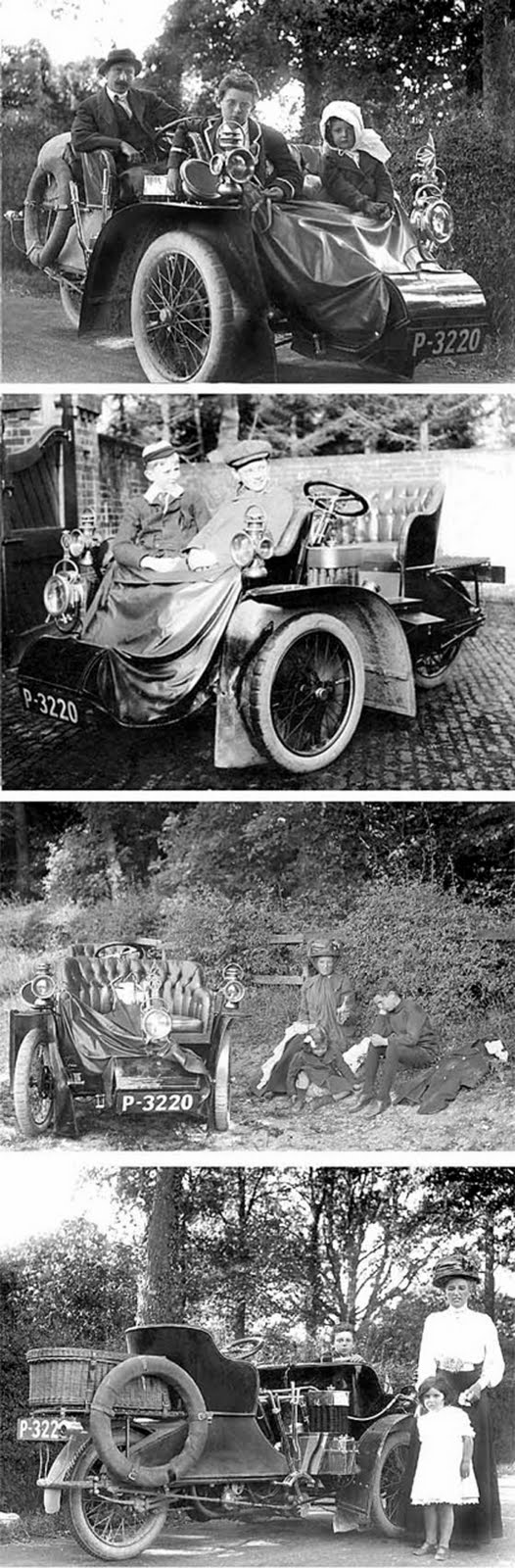 For a bigger photo of just one, (these were all small and just pieces of one large photo) see the 1906 Indian
http://justacarguy.blogspot.com/2011/03/1906-indian-tricar-sometimes-victorian.html


a variety cool and unusual vehicles from steampunkvehicles.tumblr.com
 Above, kids home made flivver. Think any kids try making their own cars anymore? Doubt it.

 Above, a MGM movie publicising sound train I haven't come across before http://justacarguy.blogspot.com/search/label/Sound%20Train
 Aero streamline tow truck... looks like a Count De Sakhnoffsky design, middle of the following post http://justacarguy.blogspot.com/2008/09/extraordinary-designer-of-automotive.html
 Custom worked Pierce Arrow?
 Above, stream line your Model T at home!
 Above, 1914 Alfa Romeo streamliner
 Above 1905 Bordeaux Cali Limousine.
 Above 1917...don't have a maker
 Above 1920 in California
 Above Queensland

 Tank on rails, WW 1? Clever that the rail rims are mounted to the ordinary tires and rims
 Gravity fed fuel system, quite the jalopy
http://steampunkvehicles.tumblr.com/ a source for many cool and unusual cars, highly recommended
Motor Cities National Heritage
 The Gilmore Car Museum received a grant from MotorCities National Heritage Area for the Gilmore Garage Works Program. The Gilmore Garage Works program helps teens learn life lessons as they restore a classic car at the Gilmore Car Museum during an after-school program.
 If your school can not come to visit us here at the Gilmore Car Museum all the above programs can visit you. Our educators will visit your classroom and present the program at no charge. Just email us for more information.
http://www.gilmorecarmuseum.org/html/content_page.php?content_id=39&
Designated by U.S. Congress in 1998 to preserve the cultural and historic landscape associated with the automobile in Southeastern and Central Michigan.
The 18th of 49 National Heritage Areas, focused on raising awareness and understanding about the impact of the automobile on this region with emphasis on increasing tourism, expanding education and encouraging revitalization.
Nearly 1200 auto-related resources have been identified in the heritage region; the largest concentration of auto-related sites, attractions and events in the world.
The Walter P. Chrysler Museum received a grant from MotorCities National Heritage Area for the Teachable Moments program. The Walter P. Chrysler Museum education programs are aligned with the Michigan Department of Education Grade Level Content Expectations (GLCEs). Programs for students in grades K-5 emphasize language arts, math, science and social studies concepts while reinforcing skills students need to be more successful on state tests.The middle and high school programs introduce students to engineering, design and related disciplines as they explore Michigan Career Pathways in a changing technological world.
Check it out at http://www.wpchryslermuseum.org/assets/attachments/WPCMEducationProgramsK_1A.pdf
The Motor Cities:
Became the "Silicon Valley" of the early 20th century, marshalling access to natural resources, transportation infrastructure, skilled labor, innovation and ingenuity, and venture capital to become the center of the global automobile industry;
Put the world on wheels by perfecting the assembly line, mass production and vertical integration for vehicle manufacturing;
Created the "five dollar day", the American middle class, the modern labor movement, and numerous wage and benefit advancements
One of the programs that Motor Cities is benefiting is the Polonica Americana Research Institute (PARI) that will guide researchers in completing three components of their history:
1) employment in the auto industry, (as many of the Big 3 were built by Polish-Americans, the unsung line workers employed by the Big Three)
2) documentation of the immigration process;
3) and a description of the economic status of the Polish village they left behind.
Cecile Jensen, Director of PARI, is seeking participants who would like to enroll in the workshops and submit their family histories. Her latest publication—Sto Lat: A Modern Guide to Polish Genealogy—will be the manual for the project. The completed family histories will expand the international knowledge of the Polish experience in the auto industry.
The Michigan State University - Vincent Voice Library received a grant from MotorCities National Heritage Area for their Lansing Auto Town Gallery. The G. Robert Vincent Voice Library is a collection of over 40,000 hours of spoken word recordings, dating back to 1888.
The MotorCities grant will enable the Michigan State University to digitize and catalog analog materials currently held within the Vincent Voice Library. Majority of materials are focused around 122 oral histories of UAW Local 602 and other GM related stories. Once digitized, the materials will be made available via the Michigan State website as "Lansing Auto Town Gallery".
For more info on the programs, grants, and donations see http://www.motorcities.org/
Langganan:
Postingan (Atom)